Below
Official blurb: "When a mysterious sea creature terrorises a remote town, a fisherman must fight to protect his family, his community, and his way of life." So, basically Jaws redux, but with accents. And an iceberg.
Below is a 2026 Netflix series, a thriller/mystery set in Newfoundland.
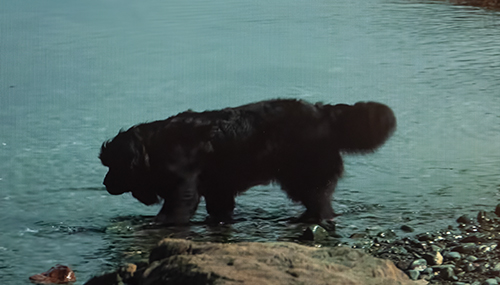
Unlike other movies or series set in Newfoundland — I'm lookin' at you, The Shipping News — this one actually includes a Newf, though barely. The dog first shows up just about 36 minutes into Episode 4, "The Ocean Will Have Us All," when the Newf comes across an injured man lying semi-conscious at the water's edge on a beach at night. The dog is onscreen for a total of about 15 seconds.
In Episode 5, "Little Pot Rock," the Newf (named "Moose" in the show) shows up just past 13 minutes in, for just a few seconds, walking along the ocean's edge. About 36 minutes in we see the Newf again, alerting on the flames of a house fire for a couple of seconds in two separate shots.
Thanks to Lars and Marij Erup for finding that the Newfoundland in the series is, in real life, a female Newf named "Relic" out of Jeanette Kinney's High Tide Newfoundlands in Torbay, Newfoundland and Labrador. Check out the kennel's Facebook page here, which includes a post on Relic's participation in this series, as well as lots of photos of some very gorgeous Newfs.
As a side note with a slight Newf connection: the tragic aspects of this series are foreshadowed in the name of the research vessel looking for the giant squid which has been terrorizing the town: the ship is the research vessel (RSV) Sir John Franklin. The Franklin after whom the ship is named was the head of a very heavily hyped 19th-Century British expedition to find the Northwest Passage. Outfitted with cutting-edge gear and supplies, and sailing in two specially modified and equipped ships, the expedition set sail in May of 1845 with a crew of 129 men. After more than a year at sea both ships became stuck in the ice, where they remained for two years, during which time many of the crew perished. The remaining crew members, despairing of rescue, eventually set out on foot across the ice, in several different groups. Not a single person survived. Several rescue expeditions were sent, resulting in more deaths, and the Franklin Expedition became a cultural touchstone for the Victorians, who treated of it extensively in books and plays and artworks. Our very own Sir Edwin Landseer painted a dramatic — and at the time rather controversial — painting alluding to the expedition, Man Proposes, God Disposes: an ice-bound Artic scene of a shipwreck and two polar bears, one of which is tearing at a ship's flag while the other gnaws on a human ribcage.