SAVED
Questions to arouse interest. What has happened? Where are the dog and the child? Why do you think it could not have been a shipwreck? Why are the sea gulls flying around? What can you see in the distance? What kind of a beach is it?
Artist: Sir Edwin Landseer (lănd´´sēr).
Birthplace: London, England.
Dates: Born, 1802; died, 1873.
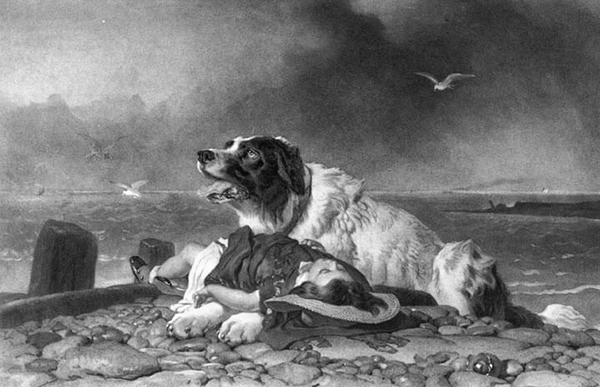
The story of the picture. This fine Newfoundland dog has just saved the life of a little child. We can see even in this print of the picture that they are both dripping wet, and so we know the child must have fallen into the water and was about to drown when the dog swam out and brought her safely to the shore.
We can only guess how the accident occurred. It could not have been a shipwreck, for then there would be others for the good old dog to save; besides, although the sky is partly cloudy, there is no evidence of a storm, and we see sailboats in the distance.
The child evidently had not been wading out into the water and gone beyond her depth, because she has on her shoes and stockings and is dressed for a day in the warm sunshine, perhaps out on the beach. Probably she had been playing on the wharf or on the rocky shore and had reached out too far or had slipped on a rock.
The dog, hearing her cry, must have immediately plunged into the water after her. Then holding the child firmly by her dress, he had battled against the waves until he reached a sandy beach from which he had dragged himself to this place.
Although we cannot see the parents, nurse, or playmates, no doubt they are running toward the child and the dog. The dog seems to be watching their approach as he lies there exhausted, guarding the precious burden lying across his paws. His great tongue hangs out and we can almost hear him pant as he gasps for breath after his fierce struggle against the waves.
The child is still unconscious, her large shade hat held by a rubber band under her chin; her arm lies limp and lifeless, yet we are sure the great dog has been in time, and she will soon open her eyes. The sea gulls circle about the two as if they were glad of the rescue, and were trying to show the parents where to find the child.
These powerful Newfoundland dogs are strong swimmers. At the first cry of alarm they usually plunge unbidden into the water, and rarely fail to accomplish a rescue. In France they are kept on the banks of the Seine as important members of the life-saving crew. Here they are carefully trained for this purpose by their masters, who throw a stuffed figure of a man into the water and teach the dogs to bring it back to shore. They are taught always to hold the head of the figure above the water. They seem to understand perfectly just what is wanted of them and why.
A story is told, and it is claimed to be true, of a woman who, while washing clothes on the bank of a river, placed her baby in the clothes basket to keep it safe. In some way the child tipped the basket, rolling out of it and down the bank into the deep water below. The woman screamed but she was helpless. Hearing her cry, a large Newfoundland dog that she had never seen before came swimming down the stream and saved the child, carrying it to the opposite shore.
The woman ran down the bank of the river and secured the help of a ferryman and his grandson, a boy about ten years old. When the boat reached the opposite shore the big dog was licking the hands and face of the cooing child, but growled and barked viciously at the people who were approaching him. No one dared go near him. They tried every device, but no, he could not be coaxed away from the baby.
At last the boy said he had an idea, and off he ran down the bank and jumped into the boat. Rowing out some distance into the river, he suddenly jumped from the boat into the water, uttering a loud cry of distress. He struggled a while, and then to all appearances sank out of sight. The grandfather knew the boy could swim and dive, and yet the suddenness with which he sank alarmed him greatly, and he called out, too.
Immediately the great dog recognized the cry of alarm and, forgetting all else, left his small charge and rushed to the help of the larger one, bringing the boy safely to the shore. Meanwhile, of course, the mother had taken up the baby. The dog, though showing surprise at the quick recovery of the boy he supposed to be nearly drowned, still determined to guard him in the same way he had guarded the baby.
About this time, however, the dog's owner, a huntsman, appeared. The dog greeted him joyously, running from the child to the boy and then to his master as if to tell him what he had done and how he had guarded them until his master came.
Many times it has been told of a Newfoundland that, when annoyed by some small dog that persisted in barking and snapping at him, he would finally seize it by the back of the neck, carry it to the river, and drop it into the water. After watching the struggles of the little dog, which seldom was able to swim, the Newfoundland would plunge in and rescue him. After that you may be sure the little dog took care not to annoy the big one.
A humorous incident is told of two boatmen who, on a wager, started to swim across a stream. When one of the men was in midstream his Newfoundland dog plunged in after him and in spite of his struggles brought him back to the shore by his hair. The crowd which had been watching was greatly amused, but the chagrined sailor was able to laugh in turn when the great animal, mistaking the emotion of the onlookers, brought the other man back also.
A lady who owned a fine Newfoundland dog allowed him one day to carry her parasol. When they came to a baker's shop she bought a bun for him. The next day the dog met another lady coming down the street carrying a parasol. He immediately seized it and ran on ahead until he came to the baker's shop. The lady went in and asked the baker to help her secure her parasol. He suggested that she give the dog a bun as his mistress had done. Then the dog gave up the parasol willingly. He had to be punished very severely before he could be broken of this habit.
Cases have been known of these dogs rescuing even so delicate a thing as a canary bird that had fallen into the water.
Intelligent and faithful, perhaps there is no other dog, unless it be the St. Bernard, which rescues travelers in the snow-covered Alps, that has done so much for man or has saved so many lives.
These dogs show remarkable kindness not only toward man but toward other animals. When another dog has been injured they have been known to carry bones and other food to it.
A Newfoundland was once taken to a dog pound with numerous other dogs. He soon gnawed his rope in two and was about to escape when, hearing the piteous cries of the other dogs, he went from one to another, setting them all free.
Even abuse will not make these loyal animals turn against a master, although they have been known to run away from a cruel one. A story is told of a man who, while rowing a boat, pushed his Newfoundland dog into the stream. The dog followed the boat for some time but, growing tired at last, tried to get back into the boat. The man pushed him away several times, finally pushing so hard that he overturned the boat and was about to drown. The good dog, however, caught hold of his coat and held him above water until help came.
In the island of Newfoundland these dogs are used much as we use horses, and are very valuable. With them duty is first. We often hear of one of these dogs carrying a basket of meat, a paper, or some other thing for his owner, and bearing any amount of annoyance from other dogs until he has delivered his charge safely; then he promptly goes back and punishes the offenders in such a way that they dare not interfere with him again.
These dogs are noble animals indeed. Their lives are devoted to man, though their devotion is not always appreciated as it should be.
Lord Byron writes:
"In life the firmest friend,
The first to welcome, foremost to defend;
Whose honest heart is still his master's own;
Who labors, fights, lives, breathes for him alone.
The rich man's guardian, and the poor man's friend."
No wonder Sir Edwin Landseer loved to paint these noble animals. Their intelligent look and, better still, their brave and noble deeds render them almost human, lacking only the power of speech. It seems sometimes as if they really do talk, and the owners of such dogs declare that their actions prove that the dogs understand every word said to them.
Sir Edwin Landseer has painted another picture of a Newfoundland dog, called "A Member of the Royal Humane Society," which looks so much like this one that it might be the same dog.
Questions to help the pupil understand the picture. What kind of a dog is this? What has he done? What makes you think he and the little girl have been in the water? that there has not been a shipwreck? Why do you think the child had not been wading? How is she dressed? How do you suppose she happened to fall into the water? How could this dog save her? Where do you suppose the child's playmates and nurse are? Where is the dog lying? Why does he not take the child to them? What makes you think he is tired? How are Newfoundland dogs sometimes trained in France? Tell about the washwoman and her baby. How was the baby rescued? Why could the mother not take the child? What did the boy do? What happened then? When were they released? How do Newfoundland dogs sometimes punish small dogs that annoy them? Why do they not drown? Tell about the two boatmen and their wager. Tell about the dog and the lady's parasol. What do these stories tell us about Newfoundland dogs? What other kind of dogs save many lives? What did the Newfoundland do at the dog pound? How do they sometimes resent abuse? Tell about the boatman and his dog. Upon what island are they used to carry burdens? Tell a story showing that duty comes first with these dogs. What other picture of this dog has Sir Edwin Landseer painted? Why do you think he was especially fond of Newfoundland dogs?
To the Teacher: Short stories of the bravery and faithfulness of dogs may take the place of other talks on kindness to animals.
Subjects for Compositions
A Description of a Newfoundland Dog.
How a Dog Saved a Child from Drowning.
The Smartest Dog I Ever Saw.
The Bravest Dog I Ever Heard of.
A Description of a St. Bernard Dog.
How to Treat a Dog.
Why We Should Be Kind to Dogs.
The story of the artist. When Edwin Landseer was a small boy he lived in the country. Nearly every day at breakfast the father would ask his boys, "What shall we draw to-day?" The three boys would take turns choosing and sometimes they would vote on it. Then out across the fields the father and his boys would tramp until they came to where the donkeys, sheep, goats, and cows were grazing. Each would choose the animal he wished to draw; then the four would sit down on the grass and make their sketches. Edwin's first choice for a subject was a cow, and his father helped him draw it.
When he was five years old he drew a picture of a dog asleep on the floor that was very much better than any his older brothers could do, and so even then they began to expect much from him.
At this time Edwin had three dogs of his own named Brutus, Vixen, and Boxer. They were always with him, and so intelligent they almost seemed to speak.
In their back yard the children had several pens for pet rabbits and they kept pigeons in the attic of their house. The story is told of how Mr. Landseer once decided to move, selected the house, and thought all was settled, when the landlord refused to rent the house to him because he kept so many animals and birds as pets.
We read of how the father and his sons made many visits to the Zoölogical Gardens where they could watch and make sketches of lions, bears, and other wild animals. One day they saw a strange sight in one of the store windows in London—a large Newfoundland dog caring for a lion. The lion had been caught in Africa when it was very little and had been cared for by this dog. They had never been separated. Now, although the lion was much larger than the dog, they were still the best of friends.
Sometimes the dog would punish the lion if it did not behave, and the great beast would whimper just as if it could not help itself. All three boys made many sketches of this strange pair and could hardly be persuaded to leave the window.
Every one knew of Sir Edwin Landseer and wanted some one of his pictures of dogs because it looked so much like a dog they knew.
In the story of the picture "Highland Shepherd's Chief Mourner," are further particulars of the life of Sir Edwin Landseer.
Questions about the artist. What other picture have we studied by this artist? Tell about Sir Edwin Landseer's boyhood. How did the brothers decide where to go to sketch? How old was Edwin when he drew a very good picture of a dog? What was the dog doing? Tell about Edwin's dogs; the other pets. Why did the landlord refuse to rent Edwin's father a house? Tell about the Newfoundland dog and the lion. What else can you tell about the artist's life?